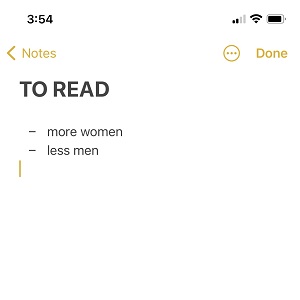
At the end of 2019 I tasked myself to only read books by women-identifying writers for 2020. Towards the end of 2019 I was adding titles to my (some may say meticulous) reading list and realized my nonfiction folder was dominated by men. This fact that I listed so many men isn’t necessarily ridiculous, but it is curious considering that the last several nonfiction works by men that I read in 2019 felt like sludging through mud. Sometimes men write as if it’s a contest between them and the reader over who knows more words. Meanwhile the last several nonfiction works by women that I read were some of the most clear and vivid works I’ve read to date. This includes Lucia Berlin’s semiautobiographical short story collection A Manual for Cleaning Ladies that I read in December 2019. She wrote only a few short story collections in her life and has one of the most crystalline voices I’ve ever read. She’s one of the primary reasons I intentionally pivoted away from male writers for 2020. It seemed inconceivable at the time to go from Berlin’s collection to yet another highly recommended male writer writing about, I don’t know, other men?
I’m not alone in this observation — Irish novelist John Boyne’s 2017 essay Women are better writers than men argues, among other things, that male writers “approach their work as if they – and not the books – are what’s important” whereas women “seem more concerned with just writing good books.” His essay was met with equal amounts of scorn and support online. And despite the fact that women are historically more avid readers than men are, the majority of critically acclaimed and lauded books are written by men. The non-profit VIDA: Women in Literary Arts (an intersectional feminist organization with diversity and parity goals for the literary sphere) has the numbers: In the VIDA Count 2019, only 3 out of 15 major publications had over 50% women-identifying and nonbinary contributors in 2019. The numbers for 2020 are still being crunched.
There’s a direct line from who gets published to who gets revered by readers. Using user data from Ranker, Wordery published this infographic of most popular fiction books in 2019. Only two women appear on this list. I’m not sure what the gender skew is of Ranker users and I personally know my more bookish friends use Goodreads, but the results aren’t too surprising. Despite accounting for almost 60% of authors in the US, women writers have an almost Sisyphean profession. And when you look at the numbers for writers of color, the numbers are dismal.
My habit of listing more books by men than women existed beyond just my nonfiction lists — my poetry, fiction, and other folders were largely occupied by male voices. I attribute this to my attempts at reading canonical works that I missed (or pretended to read) in years past. It’s not new information that most of what America deems canon literature was written by white men. There’s also a self-feeding cycle that happens in recommended reading lists or cited sources in male-written works — most of the works they reference, cite, uphold, and point to are also… get ready… written by men. This is also not new information, that writers rely on/reference other works that support their own. This is a simple truth of an appendix. But if I’m only reading nonfiction travel literature by men, and those men largely only refer to nonfiction literature written by other men, then my ever-expanding reading list becomes interlocked with this system. I felt duped when I realized this in 2019. Duped and also embarrassed that it took me so long to think about who was writing the books I was reading. So in this effort to rectify my habit of reading more men than I’d like to, I really did only read books, anthologies, and collections by women writers for all of 2020. And it was freeing.
In early 2020 I served as a juror on a murder trial; one of the books I read during my downtime was Murder on the Orient Express by Agatha Christie. I did indeed hide my book from the prosecutor during jury selection because I didn’t want to give her the false impression that I was an armchair detective here to nitpick her case. I got picked anyways. What I loved about Agatha Christie (and most of the other authors I read throughout 2020) is how she’s not heavy-handed with her characters. There’s a certain ease to her writing, versus the distinct toil male writers go through when writing about women. As a woman reader, I wasn’t distracted by antique portrayals of femininity or womanhood. I wasn’t having whiplash about clearly troubling scenes that would later have no impact on the narrative. I wasn’t keeping tabs on the male characters who were likely the author inserting himself as the hero. Instead, I found that I could trust the book, trust the author, with the story.
One week after I returned from jury duty back to my work full-time, the pandemic swept through LA County and we transitioned to working from home. Early on in Spring 2020 I tried reading some of the weightier works on my list but found myself struggling to pay attention. My typical reading time was during my lunch break in a park near my office. Now that I was working from home, my lunch was spent parked in front of my TV trying to remember a world beyond my apartment walls. The idea of reading a book when I could instead mindlessly watch TV was hilarious at the time. It wasn’t until, on a whim, I picked up a breezy novel about a group of spunky retired ladies living in Italy that I fell back into reading again. I felt shy at first when I first started reading the book but then I reminded myself that the literature gods indeed won’t smite me for having a good time. So, dear reader, if you also need the encouragement: It’s OK to read Frances Mayes novels.
I started to read heavily again in Summer 2020 and was able to fold reading back into my daily schedule. This included Namwali Serpell’s The Old Drift which is an epic generational novel set in Zambia. Serpell’s careful interweaving storylines are fascinating. This is also maybe the longest book I can remember reading (page count: 568) and I felt proud of myself for finishing after only two extensions from my library. The characters in this book were dynamic, mostly female, and unapologetically human.
During the election cycle I was reading Adrienne Rich’s Poetry and Prose collection. Hers is one of the many names I heard thrown around in college that I nodded along to and pretended I knew what my peers were referencing. In this collection, her poem Power speaks on Marie Curie’s life and her eventual death from exposure to radioactivity. The last stanza is here:
She died a famous woman denying
her wounds
denying
her wounds came from the same source as her power.
I personally know when I’ve encountered a good poem by the number of times I automatically re-read it. In this case it was four times. I won’t attempt to analyze Rich’s poetry here but I will say reading this poem in particular (and collection in general) was grounding. Marie Curie died slowly from exposure to radiation, the very thing that she brought substance to. This perspective is painful and heartbreaking; Rich found a metaphor in Marie Curie’s illness and gave it life in her poem. I just can’t imagine a male poet bringing this justice, let alone even caring to think about the significance.
I didn’t meet my book count goal for 2020 but I also didn’t meet a slew of other personal goals last year so we’ll just chalk this up to a win. Just because I dodged male writers this year didn’t mean I dodged wonky or confusing books — women can write not-so-great books too! But what I did learn from women writers is that a “good book” doesn’t need to feel like a debate between the author and the reader; a “good book” shouldn’t feel called to explain its depiction of female characters. In 2020 I didn’t find myself questioning an author’s motives. In 2020 I didn’t realize halfway through a novel that I hated the male protagonist and felt bad for the woman positioned as the villain. Instead, I read books written with emotional maturity and craft and technical skill and not once did I feel wary of where things were headed. I could just read.
Reading only women writers in 2020 was a gift I didn’t realize I was giving to myself. In a year shrouded by a pandemic, social unrest, protests against police brutality, a historic economic downturn, a president who surrounds himself with white supremacists, and countries abroad gawking at the downward spiral of America, it was comforting to turn to a book and know I wouldn’t need to fend for myself. Reading women made me feel safe in a year where we all were reminded that safety is sometimes a luxury. As I’m writing this in 2021 I still have yet to read a book by a man since 2019. Let’s see how long this streak continues.

 Jenny Winstead-Rodriguez
Interesting. Thank you. When I was going through my reviewing stats for last year I realised that I had read so many more books by women than men. I felt guilty about it. Very briefly:)
LikeLiked by 2 people