Mental health and its role in theatre instruction
An acting teacher in college gave my class an assignment one time to prepare and perform a eulogy about a loved one. The instructor asked us to imagine that our loved one had died suddenly and traumatically, encouraging us to use this as fuel in our eulogies. Not yet understanding that this assignment was not normal (to say the least), my peers and I dove into our projects. We performed for each other a few weeks later, blowing snot bubbles and weeping as we imagined ourselves at our dear family and friends’ funerals. It was after I performed my eulogy (written about my then boyfriend, who is very much still alive), I realized this acting assignment didn’t feel like acting at all.
Typically after I performed a monologue or a scene in school, I felt a sense of pride in my performance. But this eulogy felt kind of like public humiliation. Trusting my theatre instructor to know what was best, I believed him when he congratulated us on jobs well done and that this was “real” acting. To feel like an exposed nerve, raw, shattered in front of others. Now almost 10 years later with a career in theatre arts, I can unequivocally say that this exercise was dangerously unethical. Our instructor allotted no time for debriefing after our performances and we were not counseled on the delicate balance of using our own unprocessed emotions in acting. The instruction was not trauma-informed and instead seemed put together on a whim — a dangerous display of laziness and a nonchalant attitude towards young adult’s still-forming emotional landscapes. Instead, we were given positive feedback because we imagined our girlfriends smashed by buses and grandpas carried away by tornadoes. Now, apparently, we were real actors. Pfft!
This nasty memory is one of a few experiences that serve as an antithesis to my teaching instruction today. Educators have a responsibility to model healthy social-emotional skills to their students, independent of the subject taught or student age group. Mental health conversations have a deserved space in school, including in arts classrooms. So, guided by trainings in social-emotional learning and mental health interventions, I incorporate these necessary conversations. Below are a few ways I’ve successfully integrated social-emotional learning with theatre instruction.
Check-ins
At the beginning of each class, I ask my students how they’re feeling. Depending on the class size this question comes in a few forms, but my favorite is: On a scale from one to ten, one being terrible and ten being amazing, what number are you today? I ask students to shout out their number in unison. I’ve found success in developing this ritual with students, in addition to my greetings and overview of the day. It’s a pulse-check on which students may have less energy today, it’s a chance for students to be invited to chorally raise their voices, and it asks students to identify their emotions.
This exercise promotes self-awareness as well. If I hear a lot of loud tens, I’ll say something like: “Wow, that’s a lot of high numbers! Sounds like you guys have energy today and are excited to learn.” I’ve found this helps student begin to channel their zany energy into engaged learning. Or, if I heard even a few numbers under seven or eight, I’ll say: “I heard a few lower numbers, so maybe today we’ll be a little quiet or keep to ourselves. That’s OK, as long as we’re participating and doing our best.” This type of communication acknowledges students where they are at, but still sets an expectation of positive classroom behavior.
Class Agreements
Speaking of rituals with my students, I establish a list of agreements with each group I work with. I invite students to add their own agreements as well. For example, I had a new student in a class of retuning 4th graders who suggested the agreement “don’t share inside jokes too much.” Reflecting her anxious feelings of not belonging in this already tight-knit group, this agreement provided her space to share her feelings. Her peers agreed to the new rule and off we went!
Although I allow students to add agreements, my agreements always contain a few staples:
- I will respect my classmates,
- I will share talk time, and
- I will not yuck someone’s yum.
This last one always gets a giggle. The original usage of the phrase “don’t yuck my yum” refers to food preferences — if I think this meal is delicious, why would you go out of your way to tell me it’s gross? So, in my classes, a “yum” is something we’re excited about. A new idea, a character description, an action on stage. To “yuck” that would be to say the idea is stupid, the character description is bad, the action on stage is weird. To yuck someone’s yum is to be a bully, y’all! When I break this down into its components, I’ve found students embrace this logic and hold to the agreement. This exercise promotes student empathy and social awareness.
Feedback
I like to introduce peer feedback starting in 4th grade or so, depending on the class maturity level and comfort with each other. Peer feedback is crucial in theatre, and in life, but I honor the tricky tightrope that is ~opening oneself up to criticism~. In younger grades I offer feedback with phrases like “Would you like to hear what I think?” or “Can I offer you a suggestion?” to which I respect the student’s response (which is usually a yes, but sometimes not!). Modeling constructive criticism with consent at the forefront is crucial for building these skills.
Once we’re in the older elementary grades, I model feedback in a few steps. For one, I establish that we only share feedback that helps. I give examples of feedback that doesn’t help followed by how we could say it in a way that’s helpful. For example, “that’s dumb” could be changed to “I don’t understand that joke” or “that’s weird” could be changed to “why do you think your character would do that action?” Depending on the class and time allowed, sometimes I’ll perform a wonky nervous monologue and have them practice giving feedback to me. Learning about peer feedback and practicing in a safe space with clear parameters helps students begin to build their relationship skills.
Teamwork
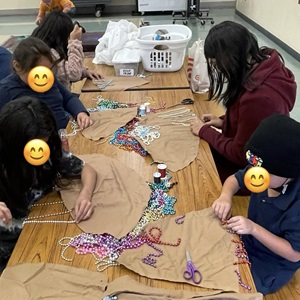
When I’m teaching a class that culminates in a production, I often have to facilitate group projects to create set pieces and props. I’m in the world of children’s theatre, so often these set pieces and props are made of cardboard and recycled materials, but they can get complex! We’ve made spaceships out of laundry carts, teleporting guns out of soda cans, Lamborghinis out of fridge boxes. Students are held responsible for making these props and set pieces during class time, oftentimes in pairs or consulting each other based on their character’s needs. I do this to promote responsible decision making, and naturally since they are making these pieces for a production, that they evaluate their progress as they go.
Before we launch into creation time, I remind students what needs to be worked on and what’s been finished. If needed, I’ll also delegate specific students to specific roles in order to ensure certain pieces get finished (and so Mrs. Jenny doesn’t have to finish them at home). Requiring teamwork and establishing timelines helps students practice self-management and organization. I had one student recently who just couldn’t get started on making a costume piece for their character — it was fairly simple with just cardboard and markers needed, but the student had decision paralysis! I let them spin their wheels on their own for a bit, monitoring from afar, until I approached and said “would you like to ask your classmates for some help?” The student lit up, gathered a small army of peers, and together they worked feverishly to make this costume piece. It took altogether five minutes tops, but all this student needed was encouragement to ask their peers for help. Group projects sometimes require mediation and conflict management, more social-emotional learning skills to develop in class.
Everyone Belongs Here
Throughout a program or class series, I reiterate to students that they each have a place in this class and in theatre. I demonstrate this acceptance through asking about pronouns (and honoring them), rethinking theatre games that have baked-in gender norms, adapting costume needs for student accessibility, and individualizing instruction based on varied student needs.
Students who don’t want to act belong in theatre class, as well. I make sure to include plenty of exercises that don’t involve standing in front of the group to be perceived. Often students don’t know what else there is to do in theatre, so teaching about the scope of work that goes into professional productions can inspire a child to find a new passion. Playwriting, stage management, box office, dramaturgy, accent coaches. And design! Scenic, sound, light, costumes, makeup, hair. I love rattling off the dozens of jobs each production needs, and seeing students gravitate into roles other than acting. Everyone is welcome in my classes.
I also acknowledge during my after-school programs that some of my students have been at their school site since 6 AM that morning due to early drop-offs, or had a turbulent day due to situations outside of their control. These students belong in the program, even if they need to put their head down for a nap, nibble on a snack, or just be alone for a moment. I maintain my high classroom behavior expectations but allow for students to be people, too.
Optimistic Closure
There has been much written on the importance of an optimistic closure in education. It’s vital to end a lesson in a meaningful way that’s planned and intentional. I like to ask: What was something that someone else did today that you really liked? This question prompts reflection and appreciation. After I’ve concluded a larger lesson, I’ll ask students to think about and share something they learned that they’ll apply after my class. This encourages forward thinking and self-efficacy. Especially in theatre arts classes, our skills are transferrable to many fields and situations. Sure, a student may not be able to shoehorn their knowledge of stage directions into other situations, but they should be able to apply their learned and practiced emotional reasoning skills in virtually any context. Ending a lesson with an optimistic closure is a crucial practice in my teaching.
So, In Summary…
If you’re an educator seeking more resources how to integrate social-emotional learning into your curriculum, theatre or not, I suggest checking out CASEL’s free SEL 3 Signature Practices Playbook. Social-emotional learning deserves to be integrated into instruction in every classroom, independent of the subject or age group. From kinder to adults, students deserve to be heard, respected, and welcomed.

 Jenny Winstead-Rodriguez