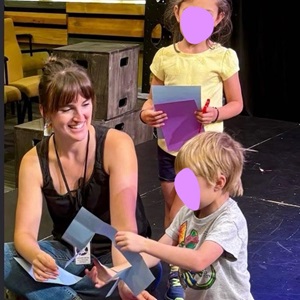
I have been teaching theatre to students since 2017, which is when I worked with Youth N.O.W in Watsonville, California at a summer camp for at-risk youth. I remember an adult checking in on my class that summer to “make sure everything’s OK” and later finding out that a boy had put a “HELP US” sign in the window that she could see in the recess yard. I was so embarrassed and felt such shame. I’ve come a long way since then, including dramatically overhauling my teaching style to incorporate individual needs of students (thank you Watsonville boy, I hope you’re doing well). That was my first foray in being a teaching artist and I’m happily now one year into doing this full-time. As I’m about to enter year two of being a full-time teaching artist, I wanted to pause and reflect on the last school year.
In the 2023-24 school year, I had art residencies at six elementary schools spanning Elk Grove Unified and Sacramento City Unified. During my residencies I taught six to 12 weeks on playwriting and theatre arts, culminating in the written product and performance of our very own play. (I had drop-in day classes at many more schools and nonprofit organizations, which I’m not counting here.) During my 2023-24 residencies, I devised 23 plays with students! This includes teaching storytelling basics, ideating characters and plot, drafting the play with students, and writing the play itself. 23 plays means at least 23 performances, which ranged from staged readings during the last day of my in-class residency to full-blown evening performances with lights, sound, costumes, props, and sets. Of these 23 performances included nine full-length plays, 12 10-minute plays, and two showcases of multiple short scenes. Some of the plays were performed several times for various audiences at the schools, which was an awesome experience for these young actors to sink deeper into their roles. Of these 23 plays, three were integrated with another subject (Ancient Egypt, ELA Theme, and Animals & Habitats) and nine were adapted from cultural stories of the students’ choosing (including folktales from Mexico, South Korea, the Tlingit people, and China). After devising the play and editing multiple drafts, we then learned about acting (voice! body! face!) and design (sound! lights! set! props! costumes!). Some students who weren’t particularly excited about the writing process almost always sunk their teeth into a design or acting challenge.
Now buckle up, I did some math. In the 2023-24 school year, my residencies impacted 486 students in Sacramento County. Ah! All of these students were in 1st to 6th grade — that’s 486 elementary students who have been through a minimum of six weeks of instruction in playwriting and the theatre arts, ultimately going home with a play that they helped write. Students were so proud of their work, and super proud when their play title suggestion was voted on by the rest of the class. Below are a few titles of the plays we created together.
- Chaos, Cringe, and Cows Who Save the Day (5th grade)
- Good Riches, Evil Wants: The Nicer You Are, The More Gold You Get! (3rd-4th grade)
- The Shot: Four Legendary Taters Save Ohio (3rd grade)
Together, we created 328 characters. Below is just a sample of the wild and colorful characters who came to life this school year.
- Joe the Dad – A villainous but also kinda cool dad from the year 2000 who hates his daughter’s boyfriend, in an ultimate quest to find some milk. (5th grade, Is There Supposed to Be a Play Title Here?)
- Earth Dragon – He is smart, a little shy, and flies in the air like a snake. He loves to make mud cakes and catch flies in his mouth. (1st grade, Zornia: Four Dragons’ Land)
- Dingleberry – A child of Ramses II, age 16 (6th grade, Who’s Your Daddy: The Best Liar in Egypt)
Sidenote: Ramses II was the protagonist of our play and our textbooks said he died at an old age… but in our play, he died by fart.
Our plays were set in faraway lands and familiar backyards, spanning continents and across galaxies. Below are a few settings from our plays.
- The interior of Heaven’s Kitchen, a new restaurant by Gordon Ramsdey – not a typo! (5th grade, Heaven’s Kitchen: Spaghetti, Soup, and Toes)
- A school classroom that looks just like our classroom, and later a football science lab on Jupiter. (1st grade, The Super Kind Kids’ Classroom)
- An evil scientist’s base, which has jumbo television screens that show tundras, waterways, forests, and deserts. (2nd grade, The Great Escape)
Each of our plays had a title, characters and their descriptions, settings, scene breakdowns, and synopses. Each play had their own exposition, climax, and resolution. Each play had a “problem” to solve and a lesson learned. While I made sure our plays followed a story arc and hit our themes created in collaboration with their classroom teacher, I also worked to make sure their jokes and references were also included. This means many plays featured references to Minecraft or Fortnite, jokes about skibidi toilet and Ohio, and plenty of silly avant-garde humor that only 1st-6th grade students think is funny. But I gotta say, seeing a classroom light up in laughter at a joke that I truly don’t understand is a wonderfully dissociative experience.
What has been a part-time gig that I did for my creative spirit and mental health has transformed into my full-time day-to-day career and I’m so thankful for my past self, my patron of the arts (husband), and my network and community for supporting the arts. Here’s to another school year, and many more plays!

 Jenny Winstead-Rodriguez